
CC to HP Calculator
There is no single formula that turns cubic centimetres into horsepower: a 1,000 cc lawn tractor engine and a 1,000 cc sport motorcycle differ by a factor of five. What you can do is estimate a realistic range from the kind of engine, using typical power per litre. This calculator does that, converts displacement units and explains what makes one engine more powerful than another.
- Free to use
- No sign-up
- Runs in your browser
Quick answer
Engine size does not convert to one horsepower figure — it depends on the type of engine. A 650cc motorcycle typically makes about 46–72 hp; a 650cc small utility engine (riding mower, generator) about 20–25 hp. Use the manufacturer’s rating when you have it.
CC to horsepower estimator
Engine Size and Power Pack
Printable engine conversion card, small-engine sizing worksheet, engine specification comparison sheet and an Excel displacement-to-power estimator.
- Conversion card (PDF)
- Estimator (XLSX)
- Spec comparison (PDF/DOCX/XLSX)
- Sizing worksheet (PDF/DOCX)
Formats: PDF, XLSX, DOCX. Instant download after payment (link valid 72 hours, up to 5 downloads). AI-assisted: the templates were drafted with AI help and reviewed and laid out before publishing.
$5.00 USD, one-time 4 files · about $1.25 each
- Instant download
- 7-day refund
- Secure checkout by Stripe
7-day money-back guarantee. Full refund within 7 days of purchase, even after you download.
Free sample: Engine Conversion Card (PDF, 74 KB)
Full refund within 7 days — see the refund policy and license.
Free printables
Single sheets you can print right now, no sign-up. The full pack adds every sheet in one download plus the editable files.
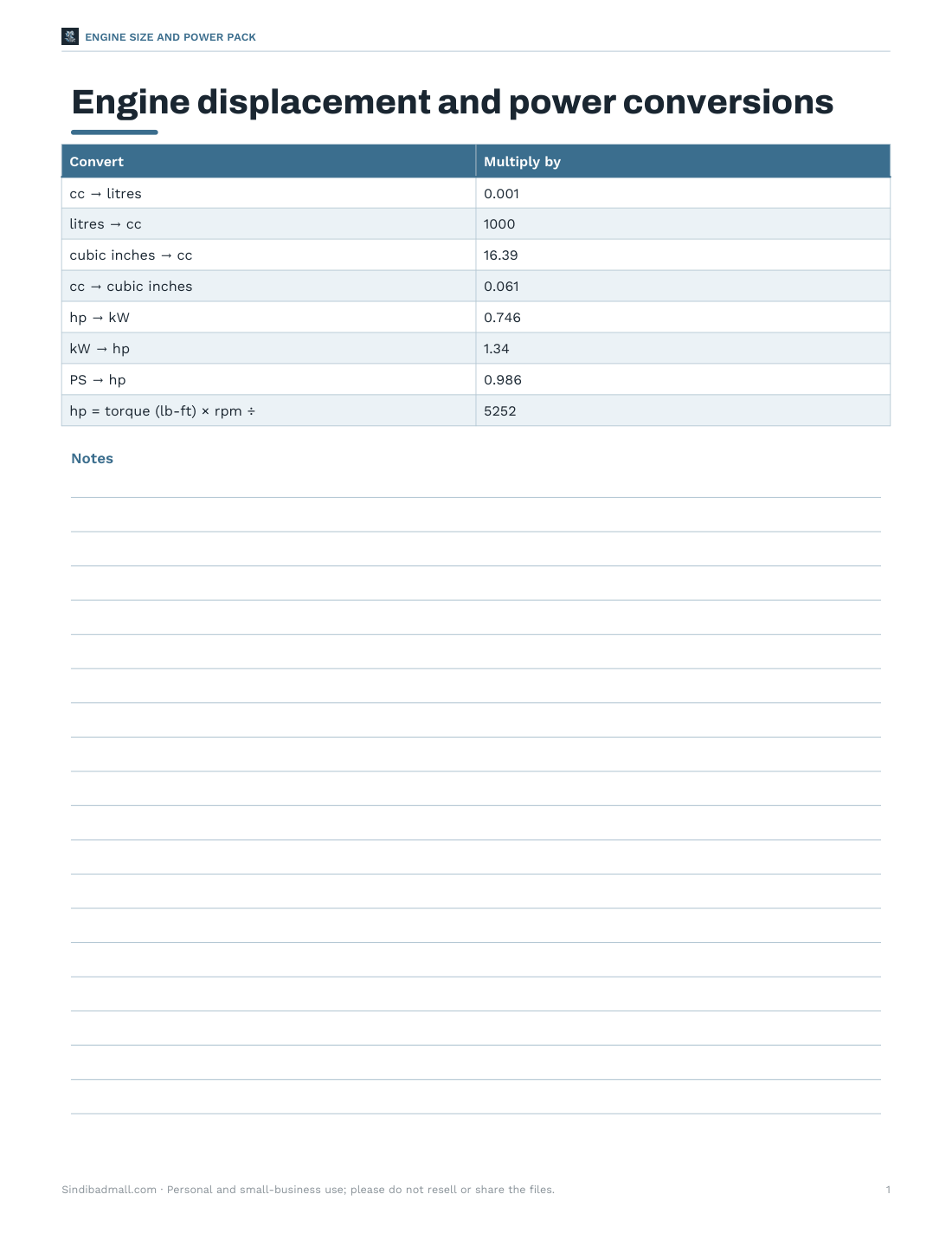
 CC to HP Calculator Conversion Card
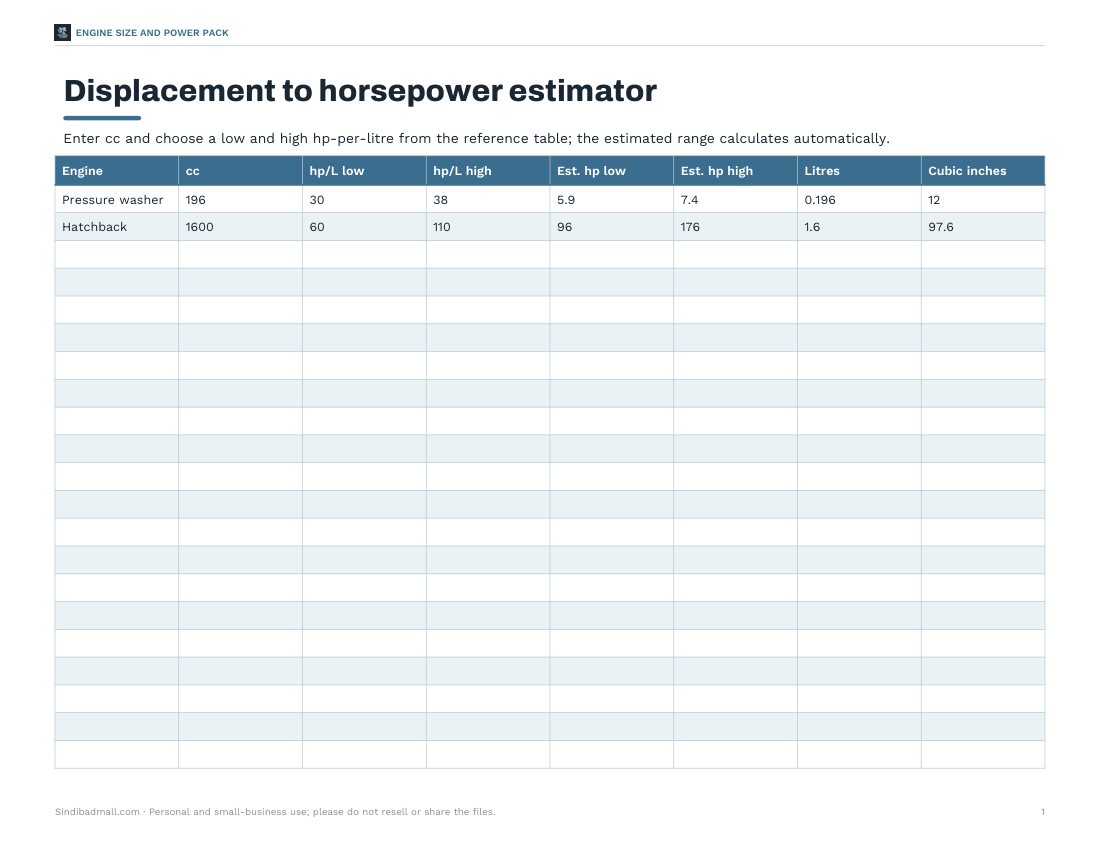
 CC to HP Estimator Chart
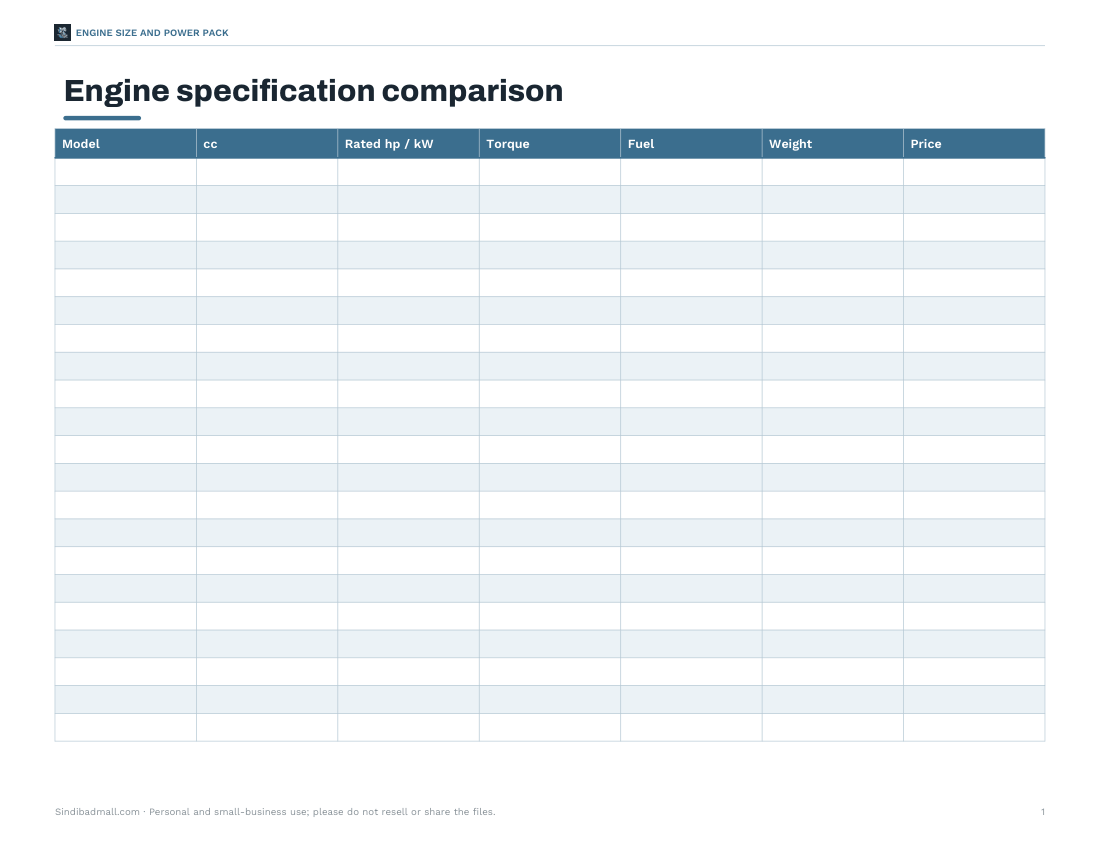
 Printable Engine Spec Comparison Chart
 CC to HP Calculator Worksheet
CC to HP chart for common engine sizes
Typical ranges from the same power-per-litre bands the calculator uses: small utility engines 30–38 hp per litre, general motorcycles 70–110, naturally aspirated cars 60–110. High-revving sport bikes and turbocharged engines make more.
| Displacement | Small utility engine | Motorcycle (general) | Car (naturally aspirated) |
|---|---|---|---|
| 50 cc | 2–2 hp | 4–6 hp | — |
| 125 cc | 4–5 hp | 9–14 hp | — |
| 150 cc | 5–6 hp | 11–17 hp | — |
| 200 cc | 6–8 hp | 14–22 hp | — |
| 250 cc | 8–10 hp | 18–28 hp | — |
| 300 cc | 9–11 hp | 21–33 hp | — |
| 400 cc | 12–15 hp | 28–44 hp | — |
| 500 cc | 15–19 hp | 35–55 hp | — |
| 650 cc | 20–25 hp | 46–72 hp | — |
| 750 cc | 23–29 hp | 53–83 hp | — |
| 1,000 cc | 30–38 hp | 70–110 hp | 60–110 hp |
| 1,600 cc | — | 112–176 hp | 96–176 hp |
| 2,000 cc | — | — | 120–220 hp |
Why cc doesn’t convert directly to horsepower
Displacement (cc) is the volume swept by the pistons — a measure of engine size. Horsepower is how fast the engine can do work, which depends on how much air and fuel it burns each second and how efficiently. That depends on engine speed (rpm), valve design, compression, fuel system, forced induction (turbo or supercharger) and tuning. So engines of the same size can differ enormously in power; specific output — horsepower per litre — captures the difference.
Typical horsepower per litre
| Engine type | Typical hp per litre | Example at that size |
|---|---|---|
| Small utility engine | about 30–38 | A 196 cc engine is often rated around 6–7 hp |
| Scooter / small commuter bike | about 50–90 | A 125 cc engine: roughly 6–11 hp |
| General-purpose motorcycle | about 70–110 | A 650 cc twin: roughly 45–70 hp |
| Sport motorcycle | about 130–210 | A 1,000 cc superbike can exceed 180 hp |
| Naturally aspirated car | about 60–110 | A 2.0 L engine: roughly 120–220 hp |
| Turbocharged car | about 90–160 | A 2.0 L turbo: roughly 180–320 hp |
| Diesel car / light truck | about 45–90 | A 3.0 L diesel: roughly 135–270 hp |
| Two-stroke | about 80–180 | A 250 cc dirt bike two-stroke: roughly 20–45 hp |
These bands are broad generalisations meant for rough estimates. Racing engines, very old designs and heavily tuned engines fall outside them.
Displacement conversions
| From | To | Multiply by |
|---|---|---|
| cc (cm³) | litres | 0.001 |
| litres | cc | 1,000 |
| cubic inches | cc | 16.387 |
| cc | cubic inches | 0.06102 |
| horsepower (mechanical) | kilowatts | 0.7457 |
| kilowatts | horsepower | 1.341 |
A “5.7 litre” V8 is about 5,700 cc or 350 cubic inches; a “1.6” car engine is about 1,600 cc.
Worked example
A pressure washer has a 196 cc engine. Using small utility engine output of about 30–38 hp per litre, the estimate is 0.196 × 30–38 ≈ 5.9–7.4 hp, which matches the 6.5 hp rating often seen on engines of that size. The same 196 cc as a scooter engine might make 10–18 hp, and as a sport-bike cylinder even more. Going the other way, 150 hp from a naturally aspirated car engine suggests roughly 1,400–2,500 cc; from a turbo engine, about 940–1,700 cc.
Horsepower, torque and ratings
- Torque is the twisting force; horsepower is torque × rpm ÷ 5,252 (in lb-ft and hp).
- Gross horsepower is measured on the bare engine; net horsepower with accessories fitted is lower.
- Wheel horsepower (from a dynamometer) is lower again because of drivetrain losses.
- Small engines are often labelled by torque (for example “9 ft-lb gross torque”) rather than horsepower since rating rules changed.
- Metric horsepower (PS) is about 1.4% smaller than mechanical horsepower (hp).
What really decides engine power
| Factor | Effect on power |
|---|---|
| Engine speed (rpm) | More power strokes per minute; sport bikes rev to 12,000+ rpm |
| Forced induction | Turbochargers and superchargers push in more air, so more fuel can burn |
| Valves and cylinder head | Four valves per cylinder and good port design let the engine breathe |
| Compression ratio | Higher compression extracts more energy from each combustion |
| Fuel and ignition | Direct injection and precise timing improve output |
| Cooling | Liquid-cooled engines can be tuned harder than air-cooled ones |
| Emissions and durability tuning | Engines built for long life at low rpm make less peak power |
That is why a small utility engine running at around 3,600 rpm makes far less power per litre than a sport-bike engine revving four times faster.
Small engine labels
Lawn and garden engines are often labelled by gross torque (for example “9.0 ft-lb”) or by displacement alone, partly because of changes to how horsepower claims are tested and advertised. When replacing an engine, match displacement, shaft size and orientation, and mounting pattern — those matter more than the power label. If a listing states a horsepower that is far above the typical range for its displacement, it may be a gross or peak figure measured differently.
When the estimate matters
Buyers use displacement-to-power estimates when a listing gives only engine size, when comparing a replacement engine for a machine, or when checking whether a quoted power figure is realistic. For licensing, insurance or tax, always use the official rated figures, since many jurisdictions classify vehicles by cc or kW.
The engine reference pack
The optional pack includes a printable displacement and power conversion card, a small-engine sizing worksheet, an engine specification comparison sheet and an Excel estimator with all engine types. The calculator on this page is free.
AI-assisted content
This page was drafted with AI assistance and reviewed before publishing. Power figures are typical ranges, not specifications for any particular engine.
Frequently asked questions
How much horsepower is 650cc?
A 650cc motorcycle engine usually makes about 46–72 hp, depending on cylinders and tuning; a 650cc small utility engine about 20–25 hp.
How many hp is 150 cc?
Roughly 8–13 hp for a scooter-type engine; small utility engines of that size make less.
How many cc is 1 hp?
There is no fixed number — it depends on the engine type.
How much horsepower does a 1000 cc engine have?
Anywhere from about 30 hp (utility) to over 180 hp (sport motorcycle).
How do I convert cc to litres?
Divide by 1,000.
How many cc in a cubic inch?
About 16.387 cc.
Is this accurate for my engine?
It gives a typical range; the manufacturer’s rating is the reliable figure.
What is the difference between hp and PS?
PS (metric horsepower) is about 1.4% smaller than mechanical horsepower.